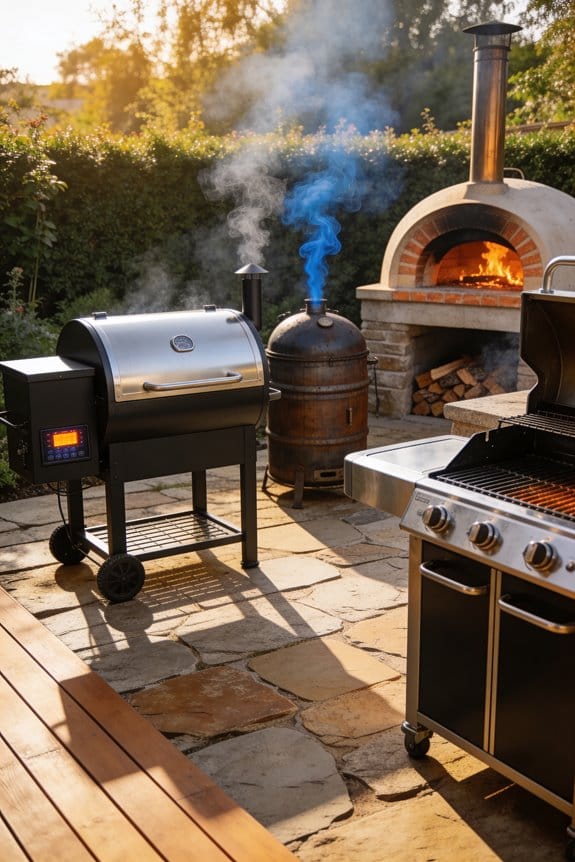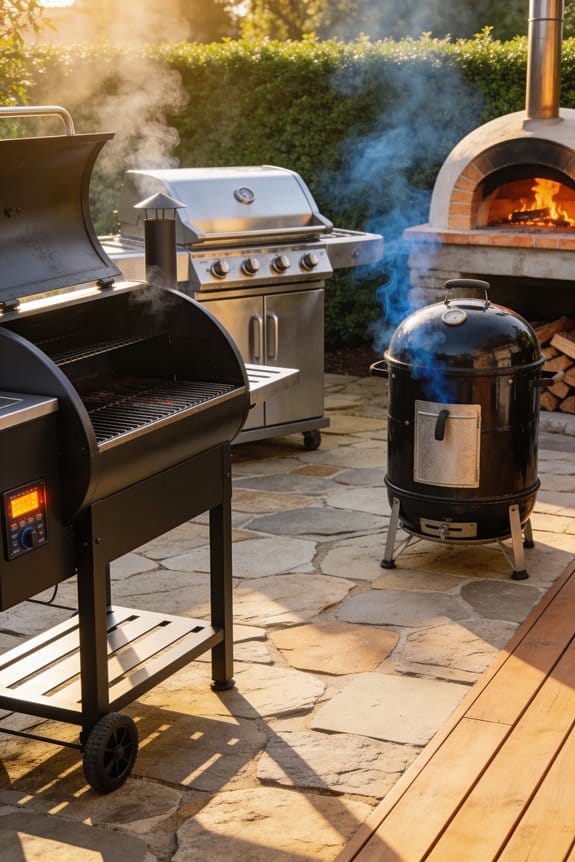


I manage fire and temperature in my offset smoker by positioning the coal bed away from the firebox door to reduce hot spots, then choosing between a V-grate method for concentrated heat or a fire basket for steady temperatures. I seal air leaks with gasket material, install a vent damper for precise airflow control, and use my stack damper as the primary temperature throttle. Adding splits before coals fully burn prevents temperature swings, while aiming for ±5–10° consistency requires continuous monitoring and predictive adjustments. Understanding how each component works together reveals the fine-tuning strategies that separate good results from excellent ones.
Key Takeaways
- Position coal bed closer to firebox door and offset from center to minimize hot zones and promote even convection-based heat distribution.
- Maintain ±5–10° temperature consistency by adjusting stack damper proactively and adding seasoned splits before coals fully consume to prevent temperature swings.
- Use a fire basket method with properly seasoned hardwood splits for steadier temperatures and cleaner burning fires with less monitoring required.
- Apply high-temperature gasket materials around seams and monitor ash buildup to ensure proper airflow, combustion, and consistent heat transfer throughout the chamber.
- Maintain thin, rolling smoke by controlling intake and damper adjustments; avoid thick white smoke indicating incomplete combustion and oxygen shortage in firebox.
Position Your Coal Bed for Even Heat
Achieving consistent temperature across your cooking chamber starts with understanding where you position your fire inside the firebox. I’ve learned that fire location matters markedly for heat distribution. When you place your coal bed directly at the throat between the firebox and cook chamber, you’ll create hot zones that produce radiative heat, which can dry out or burn your food unevenly. Instead, I position my fire closer to the firebox door for offset centering, which minimizes radiative heating. This center placement approach allows heat to distribute more uniformly across your cooking grates through convection rather than intense direct radiation. By understanding these positioning principles, you’ll achieve better temperature control and more evenly cooked results throughout your cook.
Choose Your Fire Management Method: V-Grate vs. Fire Basket

Once you’ve positioned your coal bed for even heat distribution, your next decision involves selecting a fire management method that works best for your cooking style and smoker setup. The V-grate method, which arranges two grates at a 90-degree angle to form a V-shape, concentrates coals in a small area with airflow surrounding all sides, creating a cleaner burning fire. However, splits ignite slowly and tend to smolder when your coal bed runs lower, producing thick white smoke that can overpower meat with excessive smoke flavoring.
The fire basket method offers an alternative approach. Splits catch almost instantly, maintaining steady temperatures throughout your cook with less constant monitoring. This method works particularly well if you’re using properly seasoned wood seasoning, allowing you to control your fire more easily and achieve consistent results.
Seal Air Leaks With Gasket Modifications

Your choice of fire management method sets the foundation for temperature control, but another factor works behind the scenes to determine how effectively your smoker maintains heat and smoke: air leakage around the smoker’s perimeter. I’ve found that applying smoker gasket materials around your offset smoker’s edges prevents unwanted smoke escape and stabilizes internal temperatures. When selecting gasket materials, choose high-temperature options rated for smoker environments. For installation tips, start by cleaning the perimeter thoroughly, then apply gasket material along all seams where smoke can leak. Press firmly to guarantee full contact with the smoker’s surface. This modification, combined with proper vent damper positioning, creates the sealed environment necessary for consistent heat management throughout your cook.
Install a Vent Damper for Airflow Control

Building on the sealed environment you’ve created with gasket materials, installing a vent damper at the top of your smoker gives you precise control over how much air flows through the firebox and cook chamber. This damper acts as your primary tool for airflow balancing, allowing you to throttle oxygen supply directly to your fire.
By adjusting your vent damper’s opening, you’re fundamentally controlling your draft adjustment. A more open damper increases airflow, raising temperatures faster. Partially closing it slows air movement, which reduces temperature spikes and creates smokier conditions. Think of it as a throttle for your entire smoking system.
This modification proves equally critical as your gasket work. Together, these improvements give you the temperature consistency and smoke quality you need for reliable results throughout your cook.
Control Temperature With Your Stack Damper

While the vent damper controls airflow entering your smoker, the stack damper at the top of your smokestack functions as your primary throttle for managing temperature and smoke quality throughout your cook. Stack throttling—adjusting this damper by even 25%—slows airflow and traps heat inside your pit, creating a smokier fire. This airflow balancing technique represents one of the easiest methods for controlling both temperature and smoke compared to constantly rearranging burning splits. By throttling your stack damper, you’ll achieve more consistent temperatures with minimal fluctuation. I’ve found that consistent temperature management aims for no more than ±5-10 degrees variation from your target. This simple adjustment transforms your offset smoker’s performance dramatically, making it an underutilized tool worth mastering.
Fix Hot Spots and Temperature Lag
Even with your stack damper properly adjusted, two persistent problems can undermine your smoking results: hot spots that unevenly cook your food, and temperature lag that makes maintaining consistent heat frustratingly difficult. Fire placement directly influences both issues. When you position your fire at the throat between the firebox and cook chamber, intense radiative heat creates hot zones that can dry out or burn food unevenly. Instead, move your fire closer to the firebox door to minimize this radiant heating and promote more uniform convection-style heating across your grates. Heat mapping—mentally tracking temperature variations across your cooking surface—helps you identify problem areas. Additionally, lag time exists between adding new splits and when chamber temperature rises again, requiring patience and planning ahead rather than reactive adjustments.
Prevent Temperature Swings Between Fuel Loads
Once you’ve positioned your fire correctly and managed your damper settings, you’ll notice another challenge emerges: temperature swings that occur when you add fresh splits to the firebox. Small offset smokers experience dramatic temperature fluctuations because new splits cause rapid spikes, then quick drops as they’re consumed. To minimize these swings, focus on split timing and coal seasoning. Add splits before your existing coals burn completely down, maintaining a steady coal bed. Well-seasoned coal, which has partially burned and reduced to smaller pieces, ignites more gradually than fresh splits. This approach prevents sharp temperature jumps and creates more consistent heat throughout your cook, keeping your chamber within that ideal ±5-10 degree variation range.
Achieve ±5-10 Degree Consistency
As you refine your fire management techniques, maintaining a temperature range of ±5-10 degrees from your target becomes the hallmark of skilled offset smoking. An insulated probe thermometer helps you monitor actual cook chamber temperatures accurately, eliminating guesswork. With predictive control, you’ll anticipate temperature changes before they happen. When you notice the temperature climbing toward your upper limit, adjust your stack damper slightly closed to reduce airflow and slow the burn rate. Conversely, open the damper gradually when temperatures drop. This proactive approach, combined with consistent coal bed positioning, lets you hold steady temperatures throughout your cook. Practice these adjustments repeatedly until managing heat becomes intuitive.
Troubleshoot Thick Smoke, Flare-Ups, and Dead Zones
Even with your damper adjustments dialed in and your coal bed positioned correctly, you’ll still run into common problems that throw off your cook. Thick white smoke often signals incomplete combustion, where smoke chemistry reveals an oxygen shortage in your firebox. By studying airflow visualization—noticing how smoke moves around your grates—you can identify dead zones where heat doesn’t reach food evenly. Flare-ups happen when grease drips onto hot coals, so positioning your fire away from the cooking chamber reduces this risk. If you’re using the V-grate method, expect smoldering and heavy smoke when your coal bed runs low. Consider switching to a fire basket for steadier temperatures and cleaner burns with less monitoring required throughout your cook.
Frequently Asked Questions
How Often Should I Replace My Smoker Gasket for Optimal Temperature Control?
I’d recommend inspecting your gasket seasonally and replacing it when you notice gasket wear or temperature drift during cooks. Regular seal replacement every 1-2 years maintains peak temperature control and prevents heat loss.
What Size Fire Basket Works Best for Different Offset Smoker Models?
I’d recommend matching your basket size to your firebox dimensions. A small basket works well for compact smokers, while you’ll want a large basket for bigger offset models to maintain steady temperatures throughout your cook.
Can I Use the Stack Damper to Add More Smoke Flavor to Meat?
Yes, you can use your stack damper to add more smoke flavor. By throttling it closed, you’ll reduce airflow, creating smokier conditions. However, I’d balance this carefully—too much smoke can overwhelm meat with bitter flavors rather than enhance it.
How Do I Know When My Coal Bed Needs Replenishing During Long Cooks?
When your embers glow dimly beneath ash buildup, that’s when I’d replenish the coal bed. I watch for temperature dips and visible ash layers—they’re my signals that fresh splits are needed to sustain consistent heat throughout long cooks.
What’s the Ideal Firebox Door Opening Percentage for Temperature Management?
I’d recommend keeping your firebox door partial open rather than fully closed—it gives you proportional control over airflow and temperature without needing constant adjustments. You’ll find this approach works better than opening it wider.